
TURP: Transurethral Resection of the Prostate — Proven Relief for Urinary Blockage
For decades, TURP has stood as the clinical gold standard for relieving bladder outflow obstruction caused by Benign Prostatic Hyperplasia (BPH). Performed transurethrally without any external cuts, advanced Bipolar Plasma TURP cleanly debulks obstructing prostate adenoma, restoring instantaneous high-caliber urinary flow with predictable long-term clinical outcomes.
18+ Yrs
Surgical Leadership
12,000+
Urology Surgeries
Daycare MIST
Rezūm, UroLift, iTind
Endoscopic Anatomy & Surgical Mechanism
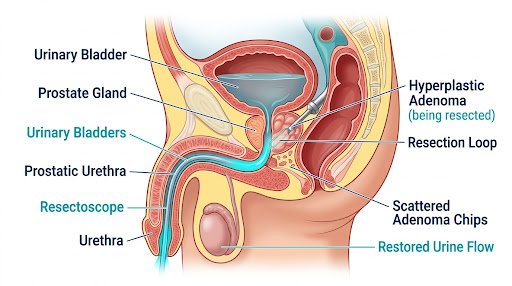
Surgical Tri-Phase Overview: Left: Obstructive Adenoma causing retention; Center: Bipolar plasma loop slicing adenoma in saline; Right: Re-established wide urinary passage allowing vigorous laminar flow.
SURGICAL PRECISION & MECHANISM: How TURP Relieves Urethral Compression
Unlike conventional open procedures, Transurethral Resection involves zero external skin cuts. Operating through the natural urinary channel with a high-definition resectoscope, the obstructing prostate tissue is shaved from the inside out using controlled electrical energy and isotonic saline.
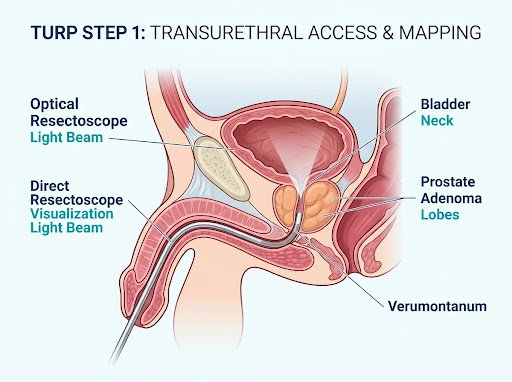
STEP 01
Transurethral Access & Mapping
Under gentle regional anesthesia, a slender optical resectoscope is navigated through the natural urethra. Dr. Chipde maps the precise prostatic adenoma margins, bladder neck, and bilateral ureteric orifices with zero skin cuts.
- Zero external incisions or skin wounds
- Continuous 4K HD digital cystoscopy guidance
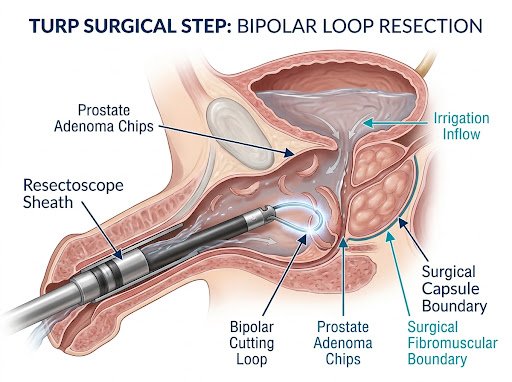
STEP 02
Bipolar Loop Resection & Cleansing
A specialized bipolar plasma resection loop emits controlled radiofrequency energy in isotonic saline, carving fine obstructing adenoma shavings while immediately coagulating micro-vessels without systemic electrolyte shifts.
- Physiological saline eliminates TUR syndrome risk
- 100% morcellated tissue collected for biopsy
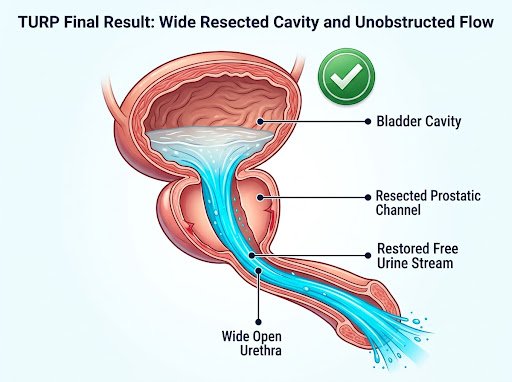
STEP 03
Decompressed Cavity & Restored Flow
The compressed, obstructed urethral passage is smoothly converted into a wide-open, funneled channel along the surgical capsule boundary. Free urine drainage is permanently restored with detrusor strain immediately eliminated.
- Immediate alleviation of urinary outflow resistance
- Smooth catheter removal within 24-48 hours
Clinical Comparison: TURP vs. HoLEP vs. Minimally Invasive (MIST)
Urological decisions must be guided by prostate volume, medical fitness, and lifestyle goals. Review the precise technical comparison below to understand why TURP remains the gold benchmark for glands under 80–100 grams.
Clinical Parameter
Bipolar TURP (Saline)
HoLEP (Holmium Laser)
MIST (Rezūm / UroLift)
Optimal Prostate Size
30g to 80g (up to 100g)
Any size (Ideal for massive >100g)
30g to 80g (Mild to Moderate)
Incisions / Scars
Zero external cuts (Transurethral)
Zero external cuts (Transurethral)
Zero external cuts (Transurethral)
Surgical Mechanism
Bipolar RF wire loop shaving chips
Pulsed laser enucleation & morcellation
Thermal steam vapor or metallic implants
Anesthesia Requirement
Spinal or General Anesthesia
Spinal or General Anesthesia
Local / Mild Conscious Sedation
Catheter Duration
1 to 2 days (24–48 hours)
12 to 24 hours
0 to 3 days
Hospital Inpatient Stay
1 to 2 nights
1 to 2 nights
Daycare Outpatient (Same day)
Ejaculatory Preservation
Retrograde ejaculation expected (~75%)
Retrograde ejaculation expected (~80%)
Preserved in >90% of cases
Histopathology Biopsy
100% pathology tissue retrieval
100% morcellated tissue retrieval
None or minimal tissue available
Durability (Reoperation Risk)
< 1% per year (10–15+ yrs relief)
< 1% lifetime risk
5–10% at 5 years
Who Benefits Most from Bipolar TURP?
TURP is specifically recommended when medical management ceases to protect bladder muscle tone or when acute obstruction compromises kidney health.
Moderate Gland Size (30g - 80g)
Prostates within this size range cause severe mechanical pinching of the prostatic urethra. TURP delivers complete, immediate desobstruction with optimal operating time under 60 minutes.
Refractory to Medical Therapy
Patients experiencing progressive hesitancy, reduced flow, or medication side effects (dizziness, postural drop, loss of libido from Tamsulosin or Dutasteride) benefit from definitive surgical debulking.
Recurrent Urinary Retention
Men who have experienced painful episodes of acute retention requiring emergency catheterization, or who have failed trial without catheter (TWOC) twice consecutively.
Secondary Bladder Complications
Chronic urine stagnation resulting in secondary bladder calculi (stones), recurrent urinary tract infections (UTIs), recurrent gross hematuria (bleeding), or bilateral hydronephrosis.
Histopathology Biopsy Need
Unlike vaporizing lasers that leave no specimen, TURP yields abundant tissue chips. This provides crucial microscopic screening for occult prostate adenocarcinoma in patients with fluctuating PSA levels.
100% Cashless TPA / Insurance
TURP is recognized as the quintessential clinical standard across all Indian private health insurance policies, PSU panels, CGHS, and Ayushman Bharat with hassle-free pre-authorizations.
The 5-Step TURP Pathway at Rajshree Apollo Hospitals
From preliminary uroflowmetry mapping to safe post-catheter discharge, every touchpoint follows rigorous international safety guidelines.
01
Pre-Op Mapping
Computerized Uroflowmetry (Qmax), post-void residual ultrasound, Serum PSA, urine culture, and anesthetic pre-evaluation.
02
Bipolar Resection
Under gentle spinal anesthesia, the high-definition resectoscope with continuous saline plasma loop debulks adenoma in 45–60 mins.
03
Tissue Pathology
Resected prostate chips are assembled and sent for comprehensive histopathological biopsy to rule out micro-malignancies.
04
Guided Recovery
A soft irrigation catheter maintains bladder rest for 24–48 hours in a private Apollo room under clinical monitoring.
05
TWOC & Discharge
Catheter is removed (Trial Without Catheter). The patient experiences instantaneous high-speed urination and walks out safely.
Frequently Asked Questions on TURP Surgery
Informed patients experience the smoothest recoveries. Review essential clinical realities answered transparently by Dr. Saurabh Chipde.
How does modern Bipolar Plasma TURP differ from older Monopolar TURP?
Older monopolar TURP utilized non-conductive glycine irrigation fluid, which carried the risk of fluid absorption into the bloodstream (known historically as 'TUR Syndrome' causing electrolyte imbalances). In contrast, Dr. Chipde utilizes advanced Bipolar Plasma TURP performed exclusively in physiological isotonic saline (0.9% NaCl). This completely eliminates TUR syndrome risk, provides superior intraoperative hemocoagulation (less bleeding), and allows extended safe resection time even for larger prostates.
Will TURP affect my erectile function or sexual intimacy?
Erectile dysfunction is very rare after TURP because the delicate cavernous neurovascular bundles that control erections travel along the outside outer surgical capsule of the prostate, safely distant from the interior channel being resected. However, most men (~70–80%) will experience retrograde ejaculation (dry orgasm), where semen flows backward into the bladder during climax and washes out harmlessly with the next urination. Sensation, climax pleasure, and intimacy remain completely intact.
How long will I need a urinary catheter after TURP?
A soft silicone three-way catheter is placed immediately following the resection to allow continuous clear saline irrigation and give the raw prostatic bed time to form a protective layer. In the vast majority of our cases at Rajshree Apollo, the catheter is removed within 24 to 48 hours once the urine becomes clear. Once removed, you will void naturally and typically be discharged home on the same day.
When is HoLEP laser preferred over TURP?
TURP is clinically optimal for prostates up to 80 grams (and select glands up to 100 grams). When the prostate gland is massive (>100g, 150g, or 200g+), HoLEP (Holmium Laser Enucleation of the Prostate) is often preferred because it separates the lobes along the capsule like peeling an orange, minimizing operative duration. Additionally, HoLEP may be favored in cardiac patients who cannot temporarily pause anticoagulant blood thinners. Dr. Chipde performs both modalities and will guide you objectively based on volumetric scans.
Is TURP covered by medical insurance and cashless TPA?
Yes, 100%. Because TURP is an established urological procedure with recognized diagnostic codes (CPT/ICD) for symptomatic BPH, it is universally covered by all health insurance providers, private TPAs, Central Government Health Scheme (CGHS), ECHS, and Ayushman Bharat at Rajshree Apollo Hospitals Indore. Our corporate desk coordinates all cashless authorizations prior to admission.
Don't Live in Agony with a Blocked Urinary Stream
Consult Central India's leading urologist, Dr. Saurabh Sudhir Chipde, at Rajshree Apollo Hospitals Indore for definitive TURP evaluation. Regain restful sleep, spontaneous voiding, and protected bladder health.
Visit Dr. Chipde at Rajshree Apollo Hospitals Indore
Conveniently accessible in Vijay Nagar, Indore. Book an express in-clinic consultation or connect on WhatsApp.
Rajshree Apollo Hospitals, Indore
- Practice Address:
Rajshree Apollo Hospitals, Sector-D, Scheme No. 74C, Vijay Nagar, Indore, Madhya Pradesh 452010
- OPD Clinic Hours:
Monday to Saturday: 10:00 AM – 06:00 PM (Sunday by emergency appointment)
- Direct Phone & WhatsApp: