
Prostate Symptoms: Nocturia, Weak Stream & Evaluation Timing
Frequent nighttime waking, reduced urinary flow, and delayed voiding are not just natural aging signs—they are treatable signals of prostate enlargement (BPH). Learn symptom patterns, self-check your risk, and understand exactly when to consult Senior Urologist Dr. Saurabh Sudhir Chipde.
18+ Yrs
Surgical Leadership
12,000+
Urology Surgeries
Daycare MIST
Rezūm, UroLift, iTind
Anatomical Comparison: Normal vs. BPH
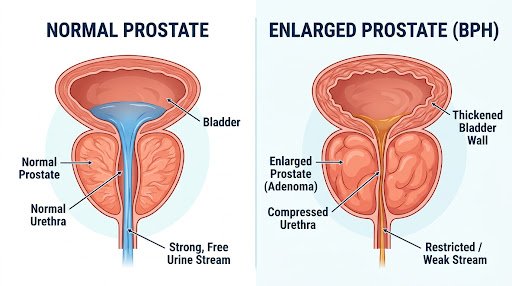
- Mechanism of Nocturia & Weak Flow: As benign prostatic hyperplasia (BPH) adenoma expands inwards, it pinches the urethral passage. The bladder muscles thicken to overcome resistance, inducing hyperexcitability and sudden nighttime spasms.
Storage vs. Voiding Symptoms: Decoded
Prostate enlargement produces two clinically distinct symptom profiles—irritative filling issues and obstructive emptying blocks. Identifying your dominant category directs exact medical treatment.
1. Storage (Irritative) Symptoms
Bladder Over-Activity & Nerve Sensitivity
Nocturia (Waking 2+ Times Every Night)
Fragmented rest caused by recurrent wake-ups to void. Leads to daytime somnolence, cardiac strain, heightened cognitive fatigue, and increased fall risks in seniors.
Urinary Frequency (>8 Times in 24 Hours)
Needing to urinate every 60–90 minutes during work or travel, even after drinking small amounts of fluids, accompanied by anxiety about finding restrooms.
Urinary Urgency & Incontinence Risk
An uncontrollable, sudden reflex urge that cannot be comfortably deferred. Severe spasms may cause involuntary urge leakage before reaching the toilet.
2. Voiding (Obstructive) Symptoms
Mechanical Channel Narrowing & Flow Resistance
Weak or Sluggish Stream
Loss of forceful urinary arc, causing a thin downward trickle. Voiding takes 2 to 3 times longer than in earlier years.
Hesitancy & Straining
Standing at the toilet waiting 30–60 seconds for urine to initiate. Many men rely on abdominal push/strain, elevating pelvic pressure.
Intermittency & Terminal Dribbling
The urine stream repeatedly starts, stalls, and restarts. Significant lingering dribble stains trousers immediately after stepping away.
Incomplete Bladder Emptying
Persistent fullness sensation in the lower abdomen even seconds after voiding, prompting back-to-back bathroom visits.
Clinical Timeline: When Should You See a Urologist?
Do not wait until complete urinary blockage occurs. Use this 3-tier clinical roadmap calibrated by Dr. Saurabh Sudhir Chipde to match your symptom severity with the appropriate evaluation speed.
Early Baseline Checkup
Suitable for men experiencing very mild or occasional fluctuations in stream without significant sleep disturbance.
- Waking 1 time per night
- Slight stream deceleration
- Age 50+ (or 45+ with prostate family history)
Action Window:
Schedule within 2–3 months
Prompt In-Clinic Evaluation
Symptom interference is degrading daily quality of life, interrupting sleep cycles, or requiring physical straining.
- Persistent nocturia (2 to 4+ times nightly)
- IPSS Score between 8 and 19 (Moderate)
- Hesitancy >30 seconds / straining to void
- Daytime travel anxiety regarding restrooms
Action Window:
Consult within 2 to 4 weeks
Immediate / Emergency Visit
Critical complications requiring urgent bladder decompression or immediate diagnostic workup to avoid renal failure.
- Acute Urinary Retention (Zero urine output + severe agony)
- Gross visible blood in urine (Hematuria)
- Painful burning voiding accompanied by fever/chills
- Flank pain, swelling, or rising Serum Creatinine
Action Window:
Immediate (Same Day / ER)
In Acute Retention or Experiencing Visible Blood in Urine?
Rajshree Apollo Hospitals 24/7 Urology Emergency triage provides instant catheter decompression and emergency endoscopic intervention.
The 5-Step Evaluation Protocol at Rajshree Apollo
Accurate urological treatment starts with exact diagnostic staging. Our Indore clinic eliminates guesswork through fast, painless, and objective clinical diagnostics in one single outpatient visit.
01
Digital Rectal Exam (DRE)
A brief 30-second tactile assessment by Dr. Chipde to determine prostate gland size, consistency, symmetry, and rule out any palpable nodularity.
02
Serum PSA Blood Test
Total and Free PSA screening to differentiate benign prostatic hyperplasia from underlying oncological prostate changes.
03
Non-Invasive Uroflowmetry
Patient voids into a computerized funnel measuring peak flow rate (Qmax in ml/sec) and total voiding curve dynamics.
04
Post-Void Residual Ultrasound
Ultrasonography scanning immediately after urination to quantify residual urine trapped inside the bladder cavity.
05
Renal Panel & KUB Scan
Evaluation of Kidney, Ureter, and Bladder integrity with serum creatinine tests to confirm no secondary upper tract compromise.
Frequently Asked Patient Questions
Clear, authoritative guidance on common prostate concerns, nocturia management, and clinical interventions.
Does frequent nighttime urination (nocturia) automatically mean prostate cancer?
No. In the vast majority of men over 50, nocturia and a sluggish stream are caused by Benign Prostatic Hyperplasia (BPH)—a completely benign, non-cancerous cellular enlargement of the transition zone. However, because early prostate cancer and BPH can coexist or present with similar obstructive traits, an in-clinic evaluation with Serum PSA testing and DRE is crucial to confirm benign status.
Can adjusting my evening water intake cure my nocturia?
Limiting large fluid volumes, caffeine, and alcohol 2 to 3 hours before sleep is helpful behavioral management. However, if nighttime waking is caused by an enlarged adenoma obstructing urine outflow or an overactive thickened bladder wall, lifestyle modification alone will not resolve the root mechanical problem. Clinical uroflowmetry will reveal if significant residual urine is remaining in the bladder.
Are prostate medications (like Tamsulosin) required for life?
Alpha-blockers relax the prostate capsule but do not shrink tissue. If stopped, symptoms recur. Moreover, long-term medication use can induce side effects like dizziness, retrograde ejaculation, or loss of libido. Modern daycare interventions (Rezūm™ and UroLift®) offer permanent mechanical clearance in a 15-minute outpatient visit, freeing patients from lifetime prescription dependencies.
What happens if an enlarged prostate is left untreated?
Ignoring worsening symptoms can lead to irreversible bladder damage (trabeculation, diverticula), recurrent urinary tract infections, bladder stones, and catastrophic Acute Urinary Retention (AUR). In advanced cases, chronic backpressure impairs renal excretion, leading to hydronephrosis and progressive kidney failure.
Don’t Ignore Nighttime Waking or Slow Flow
Restful, uninterrupted sleep and smooth, effortless voiding can be restored. Receive clear clinical clarity with Indore’s leading robotic and minimally invasive prostate specialist.
Visit Dr. Chipde at Rajshree Apollo Hospitals Indore
Conveniently accessible in Vijay Nagar, Indore. Book an express in-clinic consultation or connect on WhatsApp.
Rajshree Apollo Hospitals, Indore
- Practice Address:
Rajshree Apollo Hospitals, Sector-D, Scheme No. 74C, Vijay Nagar, Indore, Madhya Pradesh 452010
- OPD Clinic Hours:
Monday to Saturday: 10:00 AM – 06:00 PM (Sunday by emergency appointment)
- Direct Phone & WhatsApp: