
Enlarged Prostate (BPH): Comprehensive Diagnosis & Interactive IPSS Symptom Assessment
Understand your prostate health, calculate your official International Prostate Symptom Score (IPSS) in under 2 minutes, and explore minimally invasive daycare solutions with Senior Urologist Dr. Saurabh Sudhir Chipde.
18+ Yrs
Surgical Leadership
12,000+
Urology Surgeries
Daycare
Rezūm™ & Enucleation
Understanding Benign Prostatic Hyperplasia (BPH) & Anatomy
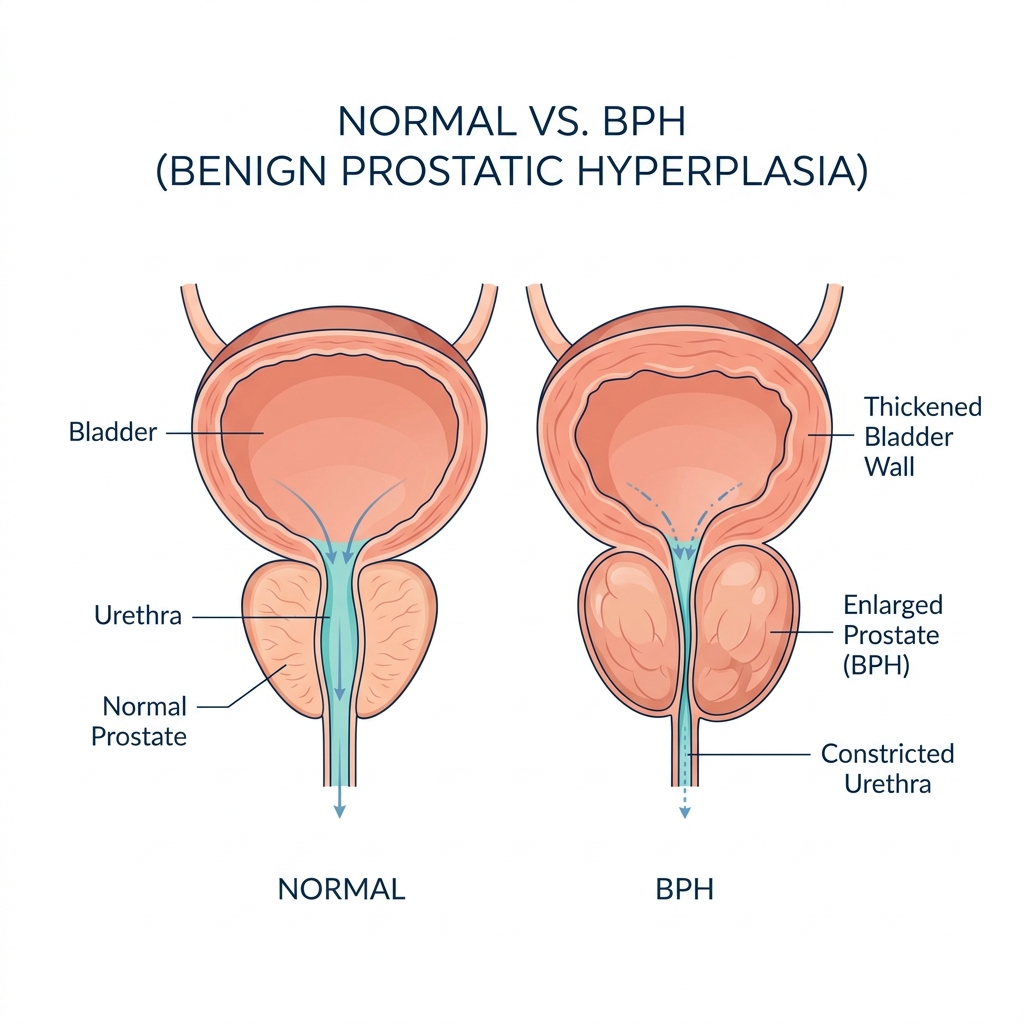
The prostate is a walnut-sized gland positioned directly beneath the urinary bladder, encircling the prostatic urethra. As men age, cellular proliferation within the central Transition Zone creates mechanical compression on the urinary outflow channel.
Figure: Progressive Transition Zone enlargement causing urethral coarctation, urine flow restriction, and secondary bladder wall detrusor hypertrophy.
- Transition Zone Proliferation
Unlike prostate cancer which predominantly emerges in the peripheral zone, BPH originates exclusively in the periurethral transition zone, physically pinching the urinary channel.
- Urethral Constriction & Backpressure
As mechanical obstruction increases, the detrusor muscle must generate two to three times greater voiding pressures, leading to muscular trabeculation, bladder wall thickening, and residual urine stagnation.
- Completely Non-Cancerous Adenoma
BPH is a benign histological condition. Having an enlarged prostate does not mean you have prostate cancer, though both conditions can coexist and require precise clinical differentiation.
50%
Men aged 51–60 experience histological BPH
80%+
Men over 70 experience obstructive urinary symptoms
20g vs 80g+
Normal walnut-sized prostate vs obstructing adenoma
98%
Successful symptom relief with targeted daycare therapies
Lower Urinary Tract Symptoms (LUTS) in BPH
Clinical presentation varies according to whether the detrusor muscle has decompensated (storage dysfunction) or outflow obstruction predominates (voiding dysfunction).
Bladder Storage Symptoms (Irritative)
Occurs during the urine accumulation phase
Severe Nocturia
Waking up 2 to 5 or more times per night, severely fracturing REM sleep cycles and causing daytime fatigue.
Sudden Urgency
A sudden, compelling desire to pass urine that is difficult to defer, occasionally accompanied by urge incontinence.
Daytime Frequency
Needing to void more often than every 2 hours during normal waking hours despite moderate fluid intake.
Bladder Voiding Symptoms (Obstructive)
Direct mechanical resistance created by the enlarged prostate
Hesitancy & Straining
Difficulty initiating the urinary stream, often requiring prolonged abdominal pressure and straining to start.
Weak & Intermittent Stream
Flow that repeatedly starts, stops, or trickles weakly rather than sustaining a robust parabolic arc.
Terminal Dribbling & Incomplete Voiding
Persistent post-void dribbling and an uncomfortable sensation that residual urine remains inside the bladder.
Red Flag Clinical Symptoms Requiring Immediate Urology Evaluation
Immediate clinical consultation or emergency intervention is warranted if experiencing: Acute Urinary Retention (AUR) (inability to pass urine), Gross Hematuria (visible blood in urine), Recurrent Urinary Tract Infections (UTIs), or elevated Serum Creatinine indicating renal backpressure.
Comprehensive BPH Diagnostic Protocol
Dr. Saurabh Sudhir Chipde implements an evidence-based clinical diagnostic sequence to accurately distinguish benign obstruction from strictures, bladder pathology, or prostate malignancy.
01
Digital Rectal Examination (DRE)
A quick, gentle clinical examination to directly assess prostate volume, tissue consistency, tenderness, and ensure the absence of firm suspicious nodules.
02
Serum Total & Free PSA Testing
Essential biochemical blood test to screen for prostate-specific antigen, establishing baseline oncological safety prior to deciding benign intervention strategies.
03
Uroflowmetry (Qmax Dynamics)
Non-invasive electronic flow rate measurement calculating peak flow speed (normal >15 ml/sec vs obstructed <10 ml/sec) and flow curves.
04
PVR Ultrasound (Post-Void Residual)
Ultrasonography measuring residual urine trapped in the bladder immediately after voiding. High residual volumes (>100-150ml) indicate detrusor decompensation.
05
Renal Function & Electrolytes
Serum Creatinine and BUN testing to ensure severe bladder outlet obstruction has not precipitated bilateral hydronephrosis or renal backpressure.
06
High-Def Digital Flexible Cystoscopy
When indicated, ultra-thin flexible fiberoptic endoscopy directly visualizes middle lobe enlargement, urethral stricture, or bladder trabeculation.
Personalized BPH Treatment Pathways
Treatment selection depends on prostate volume (grams), IPSS score, presence of median lobe, and individual patient priority for preserving sexual and ejaculatory function.
Lifestyle & Watchful Waiting
Indicated for Mild IPSS (1-7) without significant clinical bother or post-void urinary retention.
- Evening fluid restriction
- Reducing caffeine & alcohol
- Timed voiding schedules
Recovery: None needed • Repeat IPSS in 6-12 mos
Medical Pharmacotherapy
Indicated for Moderate IPSS (8-19). Daily oral therapy to relax muscle or slow glandular growth.
- Alpha-blockers: Tamsulosin, Silodosin
- 5-ARIs: Finasteride, Dutasteride
- Note: Potential sexual side effects
Ongoing daily medication compliance required
Minimally Invasive Daycare (MIST)
Preserves 100% sexual & ejaculatory function. Outpatient procedure, no major incisions, rapid return to work.
- Rezūm™ Vapor Therapy: Radiofrequency convective thermal steam dissolves obstructing prostate tissue.
- UroLift® System: Permanent nitinol micro-implants retract lateral lobes like window curtains.
- iTind™ Scaffold: Temporary 5-day nitinol remodeling scaffold.
Zero cutting • Daycare discharge same day
Advanced Laser & Robotic Surgeries
Indicated for severe obstruction, giant prostates (>80-150g), bladder stones, or urinary retention.
- HoLEP / ThuLEP: Holmium/Thulium laser enucleation
- Bipolar TURP: Plasma vaporization
- Robotic Simple Prostatectomy: da Vinci Xi platform for massive glands
1-2 day hospital stay • Definitive lifetime relief
Frequently Asked Questions About BPH & IPSS
Answers to common questions regarding prostate enlargement, medical therapies, and surgical interventions.
Does an enlarged prostate (BPH) lead to prostate cancer?
No. Benign Prostatic Hyperplasia (BPH) is an entirely non-malignant adenomatous growth originating within the transitional zone surrounding the urethra. Prostate adenocarcinoma typically develops in the outer peripheral zone. However, both conditions can occur simultaneously, which is why regular screening with Digital Rectal Examination (DRE) and Serum PSA is essential.
Can medications permanently cure an enlarged prostate?
Medications such as alpha-blockers relax the smooth muscle at the bladder neck and prostate to improve flow, while 5-alpha reductase inhibitors can modestly reduce gland volume over 6–12 months. However, medications do not permanently remove tissue and must be taken lifelong. When medications fail or cause unacceptable sexual or hypotension side effects, daycare minimally invasive therapies (Rezūm or UroLift) offer definitive relief.
Which minimally invasive treatment is best for my prostate size?
Prostates between 30g and 80g with or without median lobe enlargement are ideal candidates for Rezūm™ Water Vapor Therapy or UroLift®. For very large glands (>80-100g), Holmium Laser Enucleation of the Prostate (HoLEP) or robotic-assisted simple prostatectomy provides superior long-term anatomical clearance.
Will modern BPH treatments affect erectile function or ejaculation?
One of the greatest advancements in modern urology is the preservation of sexual function. Conventional TURP often causes retrograde ejaculation in up to 75% of patients. In contrast, modern daycare therapies like Rezūm™ and UroLift® preserve 100% erectile function and over 95% antegrade ejaculatory function.
Is the IPSS questionnaire scientifically accurate?
Yes. The International Prostate Symptom Score was developed by the American Urological Association (AUA) and adopted worldwide by the World Health Organization (WHO). It is the recognized gold standard clinical tool used globally by urologists to categorize symptom severity and track therapeutic response over time.
Take Control of Your Prostate Health Today
Discuss your IPSS score, symptoms, and minimally invasive daycare treatment options (Rezūm™, UroLift®, iTind™) directly with Senior Urologist Dr. Saurabh Sudhir Chipde at Rajshree Apollo Hospitals, Indore.
Visit Dr. Chipde at Rajshree Apollo Hospitals Indore
Conveniently accessible in Vijay Nagar, Indore. Book an express in-clinic consultation or connect on WhatsApp.
Rajshree Apollo Hospitals, Indore
- Practice Address:
Rajshree Apollo Hospitals, Sector-D, Scheme No. 74C, Vijay Nagar, Indore, Madhya Pradesh 452010
- OPD Clinic Hours:
Monday to Saturday: 10:00 AM – 06:00 PM (Sunday by emergency appointment)
- Direct Phone & WhatsApp: